Mukhathezhuthu: The Sacred Art of Ritual Facial Painting in Theyyam
Theyyam's facial paintings are not mere decoration — they are a sacred visual language. This in-depth guide decodes 15 traditional styles of Mukhathezhuthu, explaining their iconography, ritual significance, and the deities they represent.
By Puthillam Framez · · 14 min read
Vattakkannum Bhadra Chottayum
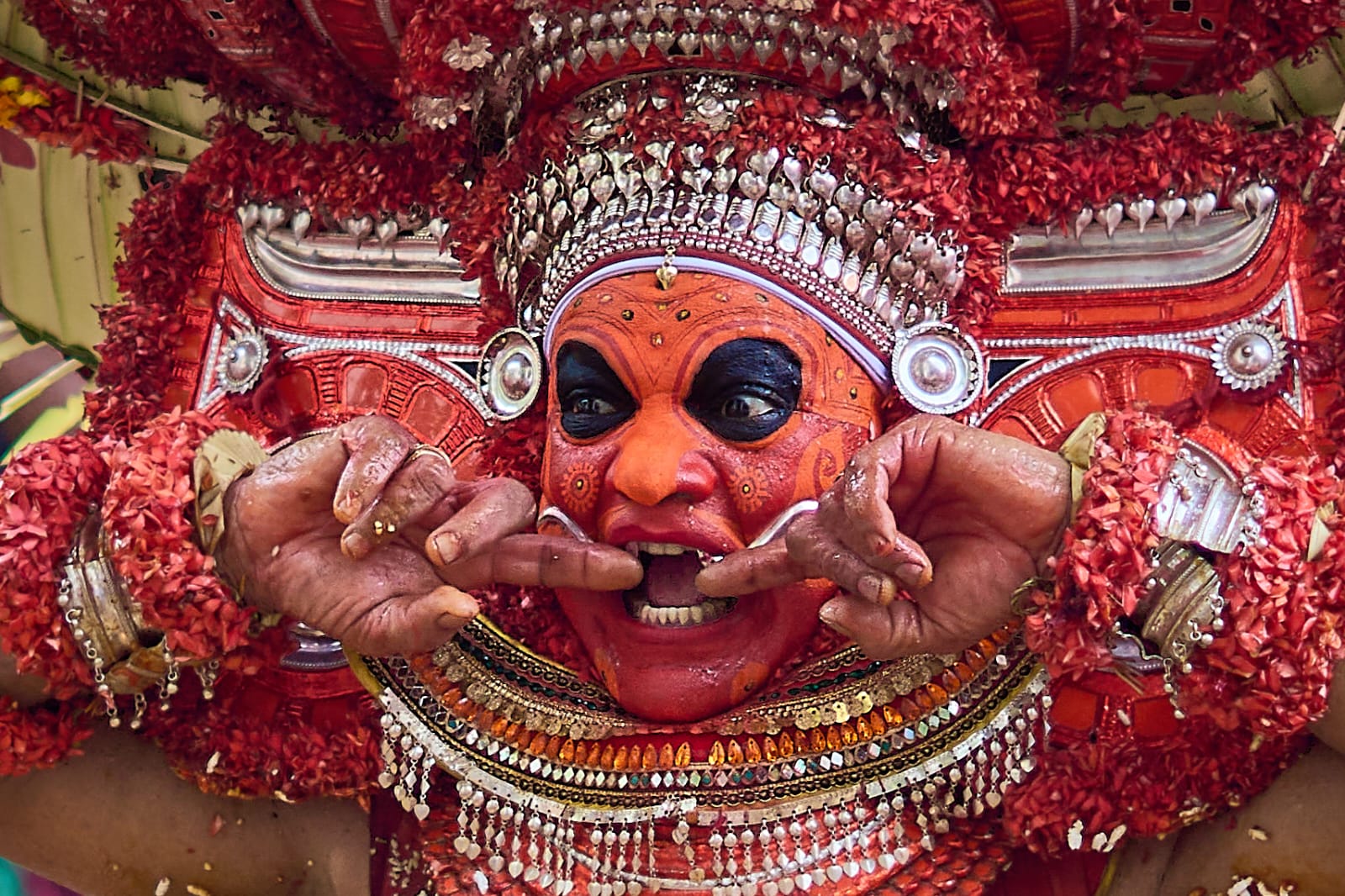
Vattakkannum Bhadra Chottayum is one of the most distinctive styles of Mukhathezhuthu — the ritual facial painting of Theyyam. The face in Theyyam is not a canvas for decoration; it is a sacred visual language that conveys the deity's nature, emotions (Bhava), mythology, and spiritual energy. Every line, colour, and motif carries ritual significance, and the facial painting style immediately identifies the deity being represented. Among the many traditional styles — including Theppum Kuriyum, Praakkazhuthu, Bhadra Chotta, Vairadalam, and Narikkuri — Vattakkannum Bhadra Chottayum is primarily associated with Bhagavathi Theyyams that embody an intensely fierce (Athiroudra Bhava) manifestation.
The name Vattakkannu literally means “round eyes.” Black pigment (Karimashi) is applied in a complete circular pattern around the eyes, symbolising alertness, divine wrath, and supernatural power. In shrines where the same deity is worshipped in a comparatively milder form, however, the black pigment is applied only around the eyelids, while Chaayilyam — a traditional cosmetic pigment — is used on the eyelids, eyebrows, and surrounding areas. These regional variations show how the same facial style adapts to reflect local ritual traditions and the deity's perceived temperament.
The forehead features the characteristic Bhadra Chotta — a series of black and red markings that form one of the defining elements of this design. This style is also known as Chottakkuri and Chuyyam Vairadalam, names that reflect regional terminology rather than entirely different designs. Together with the circular eyes, these markings create a powerful, intimidating appearance intended to communicate the fierce aspect of the Goddess.
Several decorative elements complete the composition. Chaayilyam is applied beneath the eyes and below the mouth. Floral motifs representing Erinjipoo blossoms are painted on the cheeks using Manayola, while an Erinjipoo is also painted on either side of the mouth. Some traditions instead depict two Erinjipoo motifs beneath the mouth along with a red patch symbolising blood. Above the eyes, sharp pointed red strokes called Mullukal (“thorns”) intensify the deity's fierce expression. Every element together expresses the deity's Roudra Bhava — its terrifying, protective, and awe-inspiring form.
Creating this facial painting demands exceptional skill and years of practice. The Koladhari's unique facial proportions require the artist to carefully balance every line so that both halves remain perfectly symmetrical — a precision that makes Mukhathezhuthu an art form in its own right.
While primarily associated with fierce Bhagavathi Theyyams, the use of this style varies by locale. It is commonly seen in Chudala Bhadra, Kakkara Bhagavathi, Dhooliyaanga Bhagavathi, and Dhoomaa Bhagavathi. In some regions it is also used for Narambil Bhagavathi, Kakkarapothi, Kaattupothi, and Pazhichiyil Bhagavathi. Interestingly, it also appears in comparatively gentle (Saumya Bhava) Theyyams including Cheruvicheri Puthiya Bhagavathi and Kuttoor Mailancheri Bhagavathi — demonstrating that while Mukhathezhuthu generally reflects the deity's nature, regional customs and temple traditions also shape its application.
Praakkazhuthum Mankannum Villukkuriyum
Praakkazhuthum Mankannum Villukkuriyum is a distinctive style of Mukhathezhuthu characterised by three defining features: Mankannu (deer eyes), Villukuri (bow mark), and Praakkazhuthu (pigeon’s neck).
The eyes are painted with black pigment in the shape of a deer’s eyes, which is why this feature is known as Mankannu. On the forehead is a bow-shaped marking called Villukuri, painted in black and decorated with small yellow dots.
Below the eyes, close to the nose, is a unique marking that resembles a pigeon pecking. This motif actually represents the neck of a pigeon, giving rise to the name Praakkazhuthu (“pigeon’s neck”).
This highly distinctive style is extremely rare and is found only in a handful of Theyyams, most notably Neeliyar Bhagavathi of Maangaattu Neeliyar Kottam. However, in places such as Mathamangalam and Ezhilodu Karaattu, Neeliyar Bhagavathi is adorned with a different style known as Praakkazhuthum Valiya Shankhum.
Praakkazhuthum Valiya Shankhum
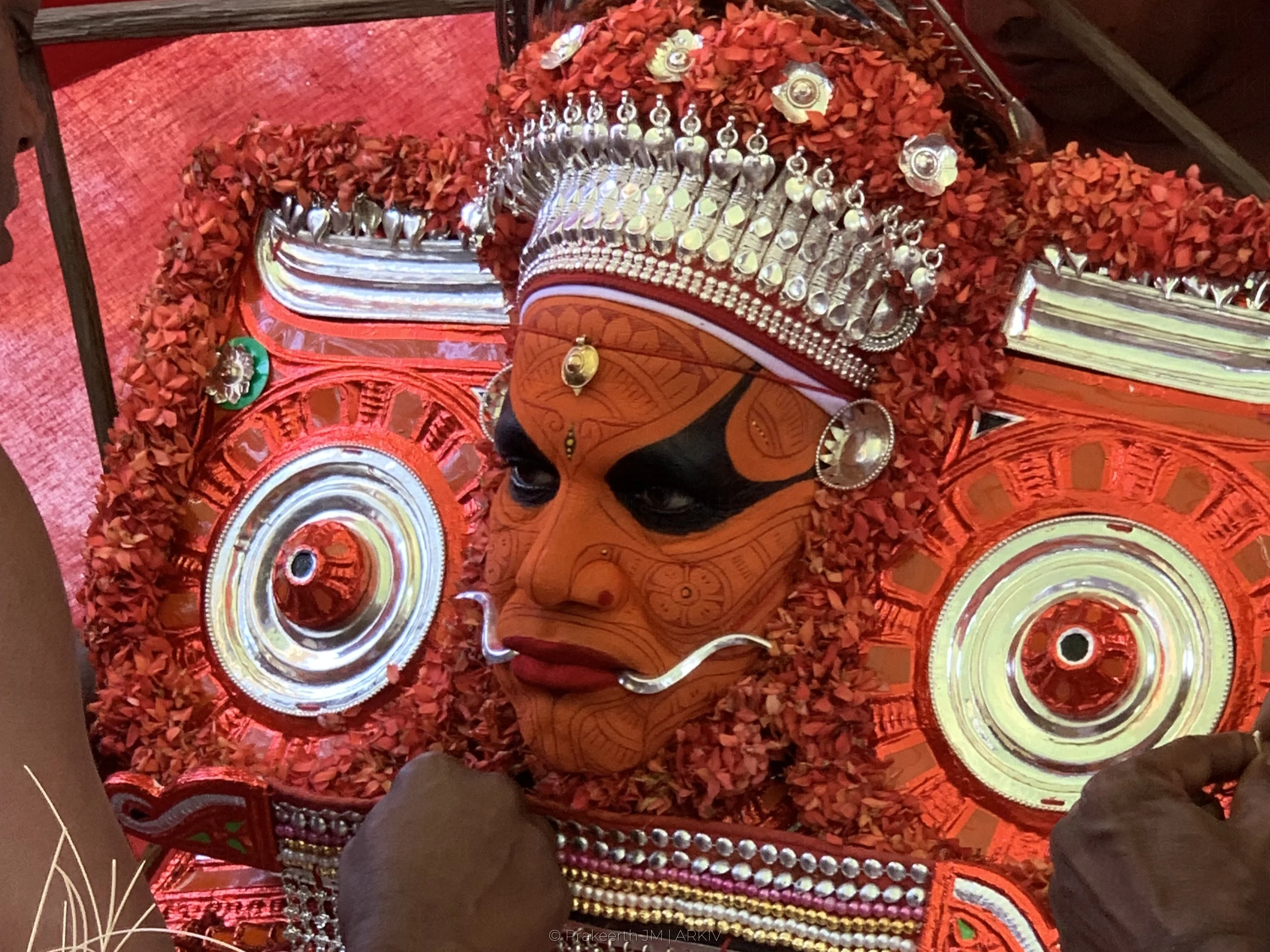
Praakkazhuthum Valiya Shankhum is a traditional style of Mukhathezhuthu commonly seen in many Valiya Mudi Theyyams performed under the concept of the Thaai Paradevatha (Mother Goddess). This style is associated with deities such as Vallarkulangara Bhagavathi, Arathil Bhagavathi, and Varikkara Bhagavathi.
When the black pigment around the eyes is painted in the form of a Shankh (conch), the design is classified as either Kutti Shankh (“small conch”) or Valiya Shankh (“large conch”), depending on its size. In the Valiya Shankh style, the conch extends upward with a long, sweeping tail reaching onto the forehead, creating a striking and elaborate appearance.
Below the eyes is a motif resembling the neck of a pigeon, known as Praakkazhuthu (“pigeon’s neck”). The beak of the pigeon is represented above the performer's nose. At first glance the design resembles a pigeon pecking at grains of rice, which is why this pattern is also sometimes called Praakkezhuthu. Another interpretation suggests that “Praak” means “ancient” or “primordial,” leading to the belief that this may represent one of the oldest styles of facial painting. The decorative patterns painted on the cheeks are known as Kilikkathi.
Praakkazhuthum Valiya Shankhum is regarded as one of the most intricate styles of Mukhathezhuthu, requiring exceptional precision, patience, and considerable time to complete.
Pullittu Ezhuthu
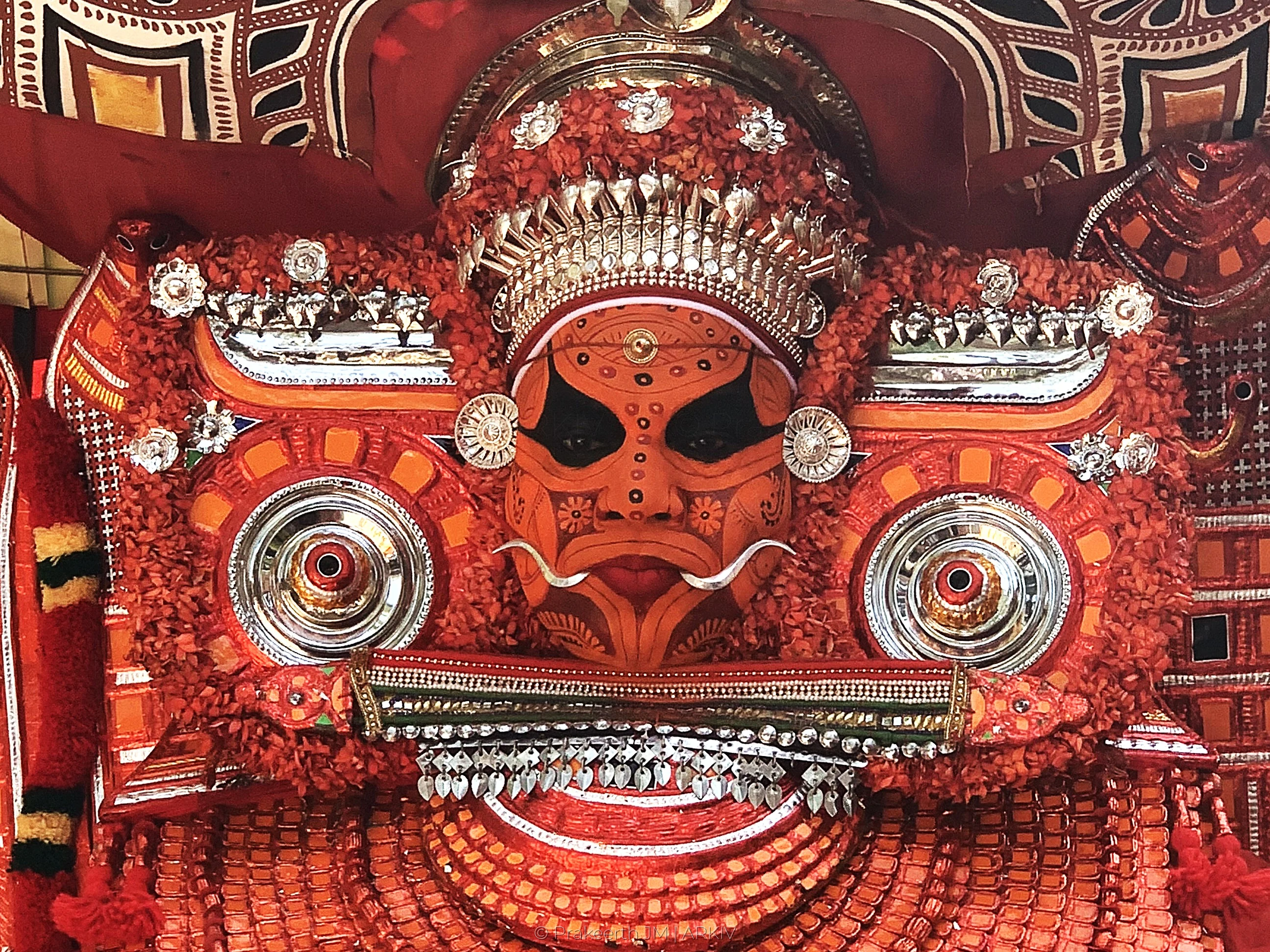
Pullittu Ezhuthu is a distinctive style of Mukhathezhuthu associated with Dandiyangaanath Bhagavathi, also known as Kammadathamma. Unlike the Praakkazhuthu style seen in most Valiya Mudi Theyyams, this facial painting follows a unique design known as Pullittu Ezhuthu.
The name originates from the depiction of a Pullu bird painted on the performer’s cheeks. The bird is illustrated with its head turned back towards its own body, as though pecking or preening itself — giving this facial painting its distinctive identity.
The black pigment applied around the eyes is in the Valiya Shankh (“large conch”) style, with the conch-shaped design extending upward, its tail reaching onto the forehead. On the cheeks, alongside the Pullu bird motif, an Erinjipoo flower is painted on each side, completing the characteristic composition of this unique Mukhathezhuthu style.
Kodum Purikavum Erinjipoovum
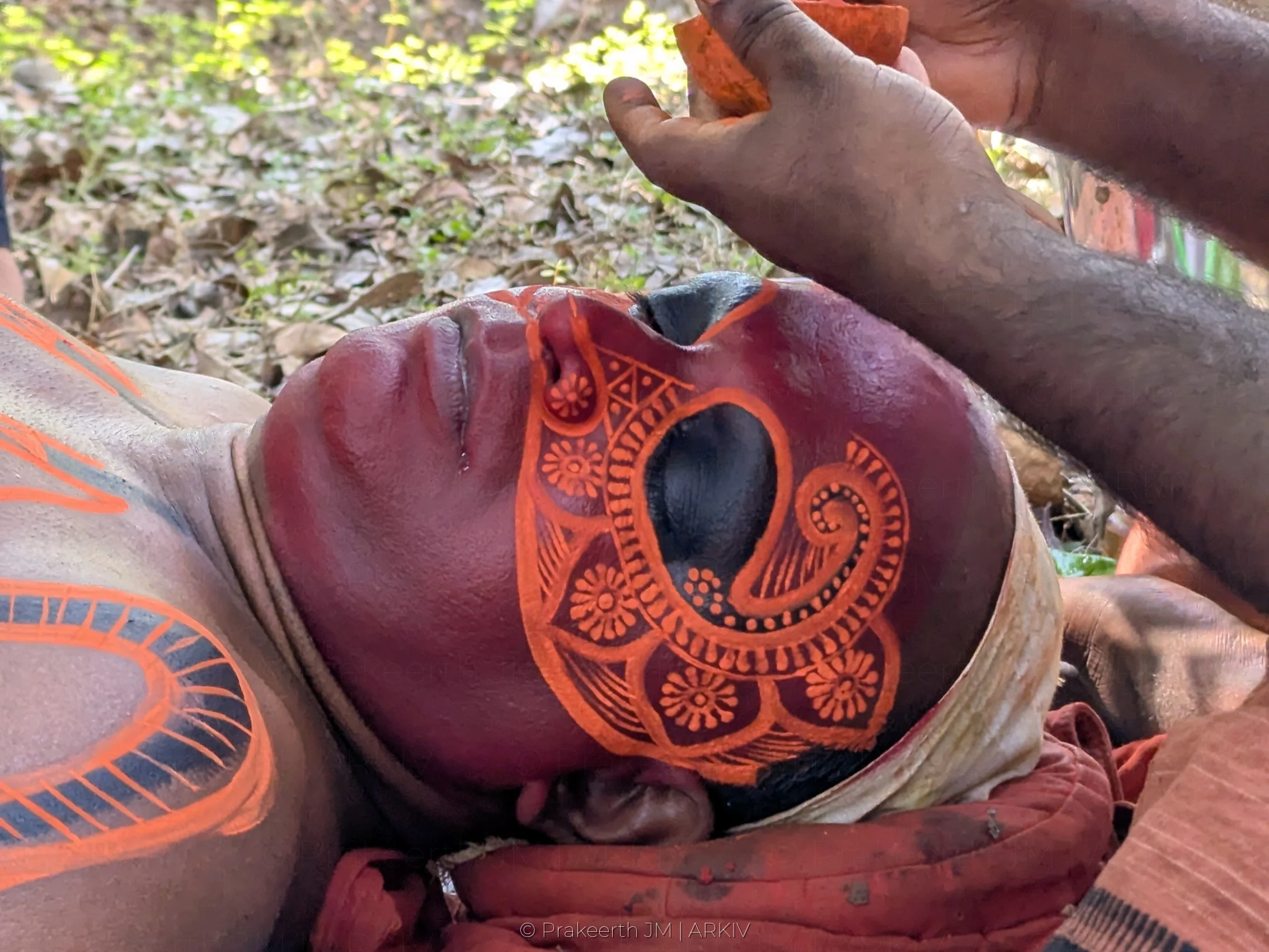
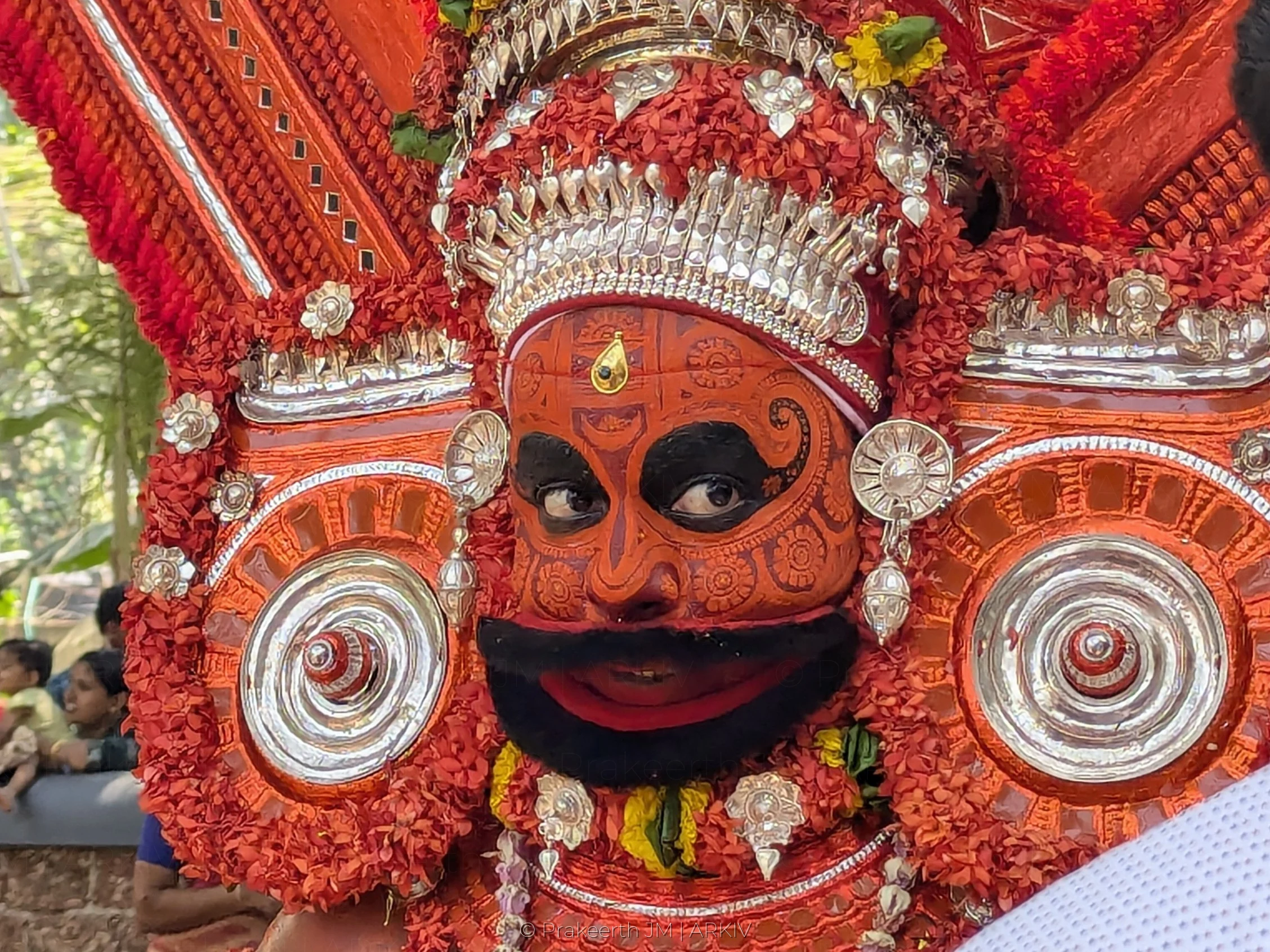
Kodum Purikavum Erinjipoovum is a traditional style of Mukhathezhuthu commonly associated with male deities in the Theyyam tradition. It is most frequently seen in Theyyams such as Oorpazhashi and Poomaruthan.
The defining feature of this style is the Kodum Purikam — the bold, upward-rising section of the facial painting that begins near the eyes and extends onto the forehead. This element gives the face a fierce and commanding expression.
The eyes are outlined with black pigment, and the extended tail of the eye design is painted in the shape of a scorpion’s tail. Above the black eye lining, small decorative dots made with Manayola are applied, adding depth and contrast to the composition.
On both sides of the face, Erinjipoo floral motifs are painted — typically three flowers on each side, creating a balanced and symmetrical design. Another characteristic feature is a Manayola motif painted on the forehead above the eyes in the shape of a Muthira Vaal (horsegram sword), an element traditionally known by that name. From the forehead, the design continues downward towards the nose, completing the characteristic appearance of this Mukhathezhuthu style.
Narikkurichezhuthu
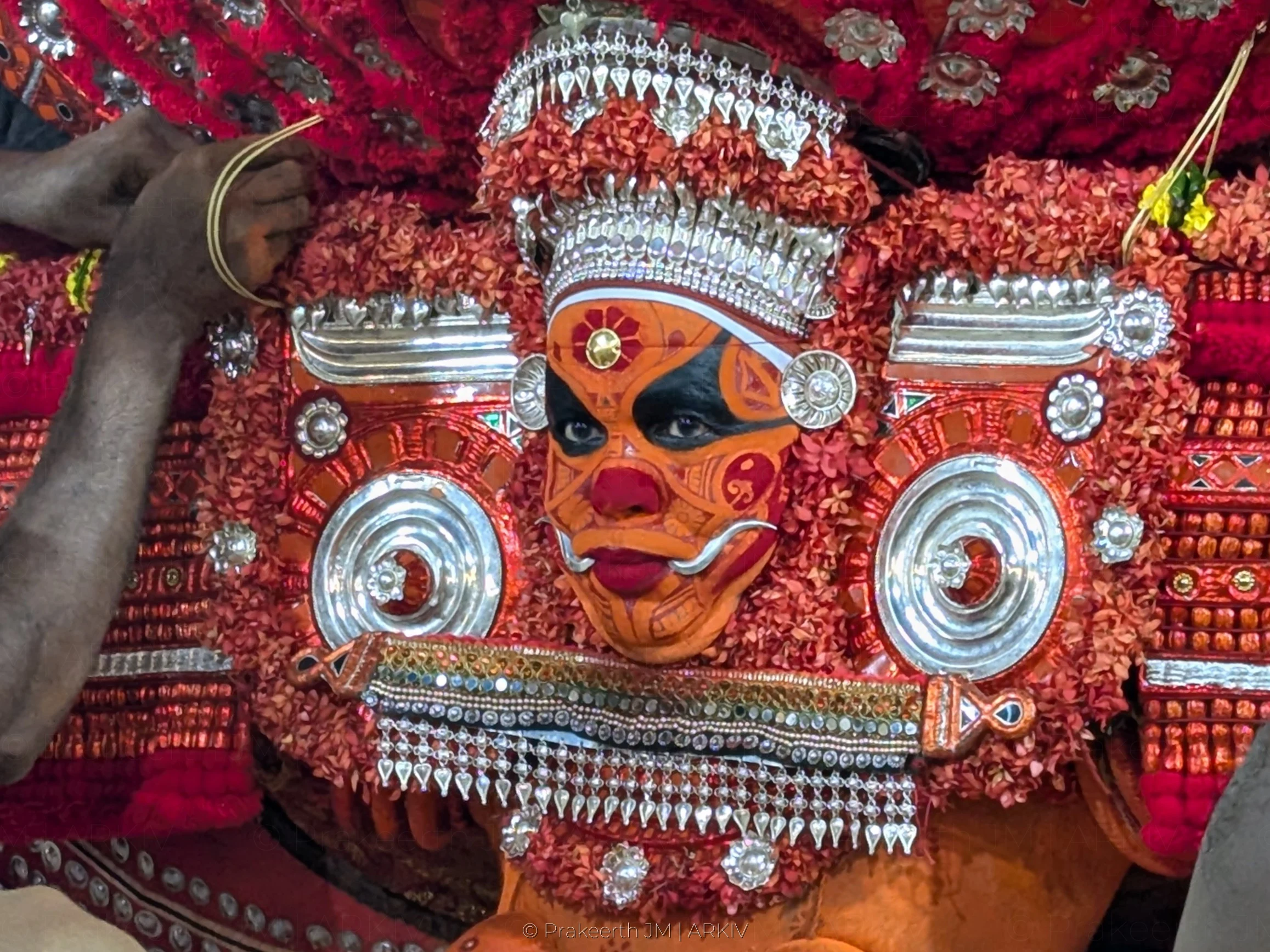
Narikkurichezhuthu is a distinctive style of Mukhathezhuthu commonly associated with Theyyams such as Puliyoor Kali and Pulli Karinkali. The defining feature is the depiction of a fox painted on both sides of the face. Beginning near the ears and extending towards the cheeks, the fox is illustrated with its head and forelegs outstretched — giving the style its name, Narikkurichezhuthu (“fox motif facial painting”).
The fox motif is painted using Chaayilyam, while finer details such as the eyes, mouth, and facial features are rendered with Manayola. The eyes are outlined with Karimashi (black pigment), and the tail of the eye design extends upward onto the forehead. At first glance this eye tail may resemble the Kookkiri Vaal, but it has its own distinct characteristics.
Regional variations are observed in the Kanhangad area, particularly in temples where the Aayirathiri ritual is performed. In these temples, the facial painting of Pulli Karinkali differs slightly — the black eye design is executed in the Valiya Shankh (“large conch”) style instead of the conventional form.
The forehead is adorned with a Chullippoovu motif at its uppermost point, below which an Erinjipoo motif is painted. Beneath the nose, Chaayilyam is applied on both sides, with an Erinjipoo flower painted above each section. Some regional traditions also feature floral motifs on either side of the nose.
Kutti Shankhum Praakkazhuthum
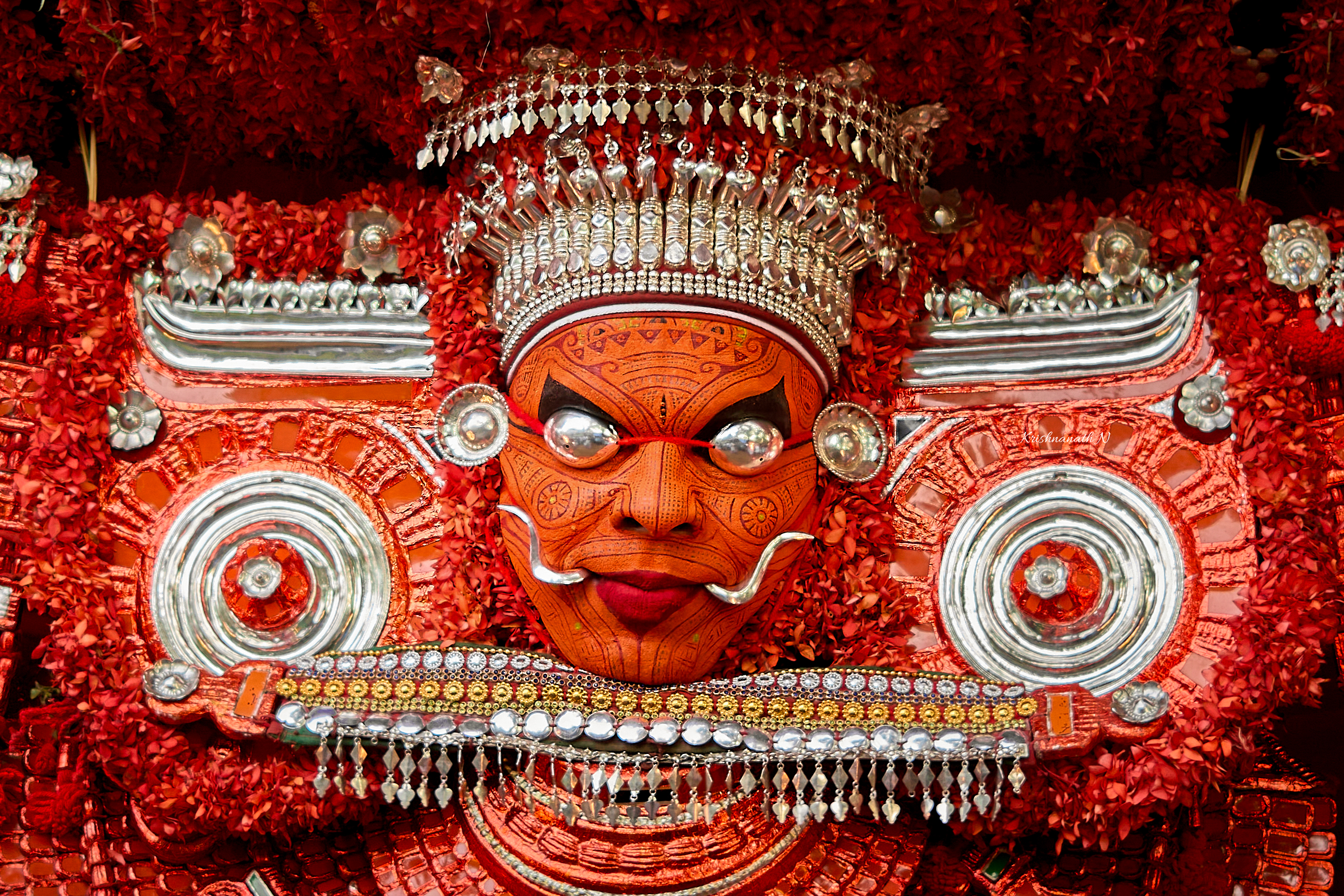
Kutti Shankhum Praakkazhuthum is a traditional style of Mukhathezhuthu used exclusively for a small number of Amma Theyyams, including Muchilottu Bhagavathi, Kannangattu Bhagavathi, and Kaniyal Bhagavathi.
The defining feature is the Kutti Shankh (“small conch”) eye design. The eyes are outlined with Karimashi in the shape of a small conch, distinguished by its short tail — hence the name Kutti Shankh.
Below the eyes, on both sides of the face, are the characteristic Praakkazhuthu motifs. The name (“pigeon’s neck”) is derived from their resemblance to the neck of a pigeon, with the pigeon’s beak depicted over the bridge of the nose. Today the term Praakkezhuthu is also commonly used.
The cheeks are further decorated with traditional patterns such as Kilikkathi and Mullu, completing the characteristic composition.
The principal distinction between Kutti Shankhum Praakkazhuthum and the Valiya Shankhum Praakkazhuthum style lies in the eye design. In the Valiya Shankh style, the tail of the conch-shaped pattern extends upward onto the forehead; in the Kutti Shankh style the tail remains short and does not reach the forehead.
Vaalittezhuthiya Kannum Theppum Kuriyum
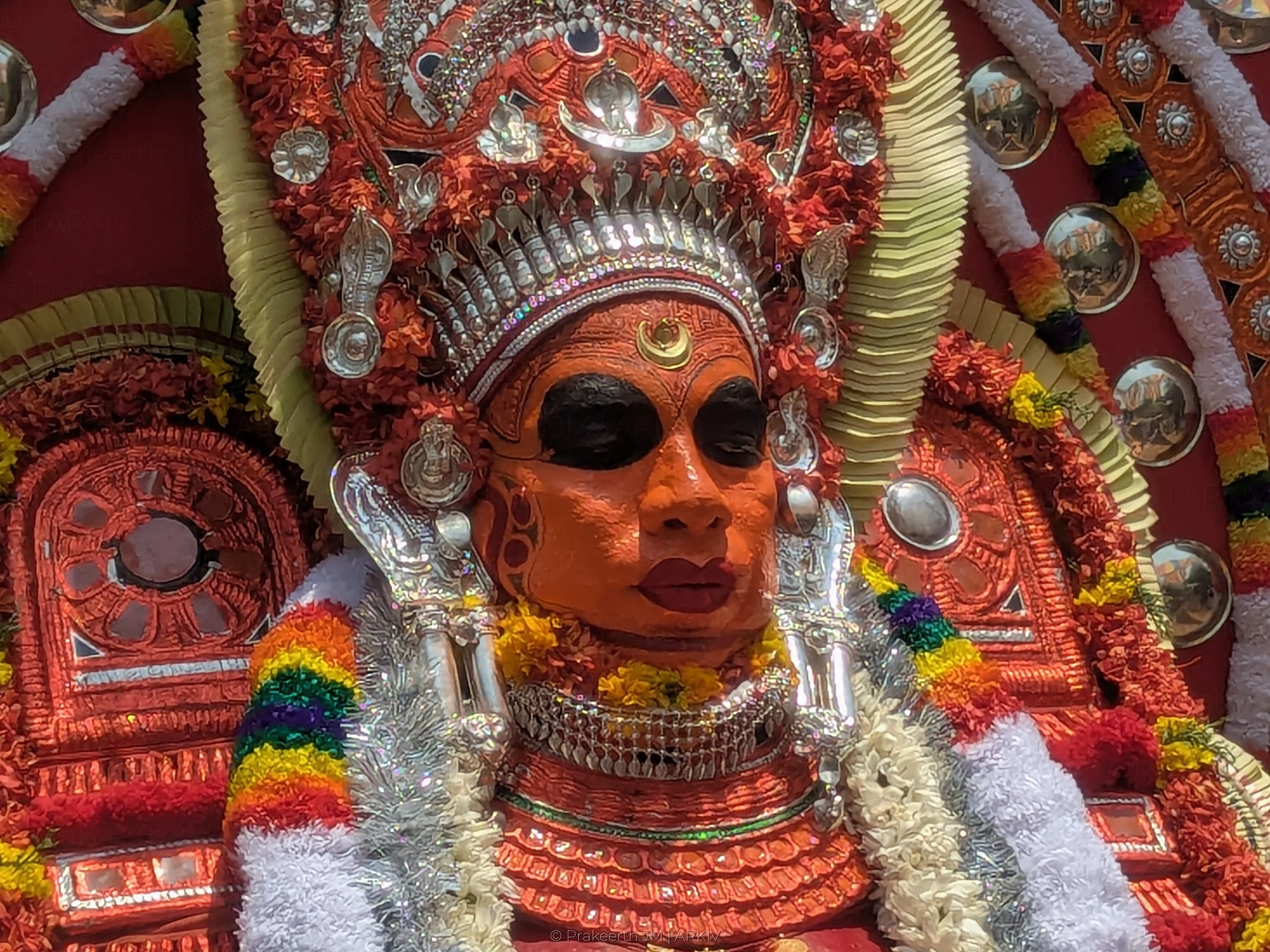
Vaalittezhuthiya Kannum Theppum Kuriyum is a traditional style of Mukhathezhuthu commonly found in several Chamundi Theyyams. The name is derived from two characteristic features: the tailed eye design and the simple Theppu technique.
The eyes are outlined with Karimashi (black pigment) and finished with a short tail, giving rise to the name Vaalittezhuthiya Kannu (“tailed eye”). Some practitioners, however, maintain that this eye pattern should more accurately be classified as Mankannu (“deer eye”).
The term Theppu refers to the simple application of Manayola across the face, without the elaborate decorative patterns seen in more intricate styles. The design painted on the forehead is known as the Kuri, of which three principal forms are traditionally used: Chandrakkala (crescent moon), Pushpam (flower), and Thrikkannu (third eye). Each Theyyam generally features one of these three forehead motifs.
This style is used for the majority of Chamundi Theyyams. It is also seen in certain male Theyyams such as Bhairavan and Velutha Bhootham. Among male deities, however, the Vattakkannu (“round eye”) design is generally more common than the tailed eye. In regions south of Nileshwaram, the forehead — referred to by Theyyam artists as the Nethram — often features an additional motif known as Peedakkaalittezhuthu, a regional variation described separately.
Mankannum Kozhippoovum
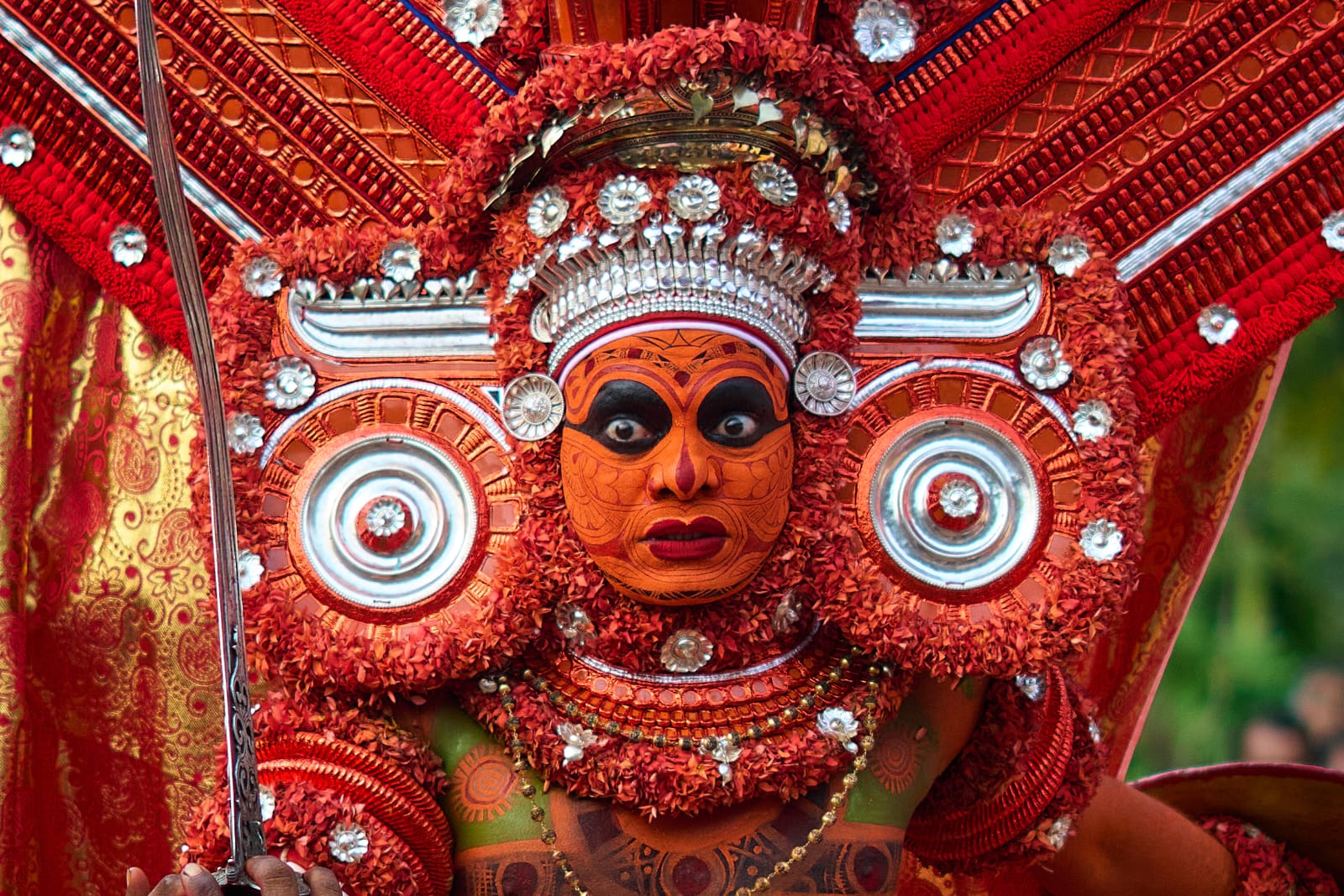
Mankannum Kozhippoovum is a traditional style of Mukhathezhuthu used for male Theyyams such as Veera Bhadran, Vairajathan, and Vadakkan Kodi.
At the uppermost part of the forehead — referred to by Theyyam artists as the Nethram — a Chullippoovu motif is painted. The eyes are outlined with Karimashi in a shape resembling the eyes of a deer, giving the style its name Mankannu (“deer eye”). Above the eyes, the eyebrows are painted with Chaayilyam, completing the characteristic eye design.
Below the eyes, three Kozhippoovu (“rooster flower”) motifs are painted on each cheek. Adjacent to each Kozhippoovu is a smaller floral motif known as the Paathippoovu, which forms an integral part of the overall composition.
The combination of the Mankannu eye design with the distinctive Kozhippoovu cheek motifs gives this style its characteristic appearance and distinguishes it from other traditional facial painting styles used in Theyyam.
Kodumpurikavum Kozhippoovum
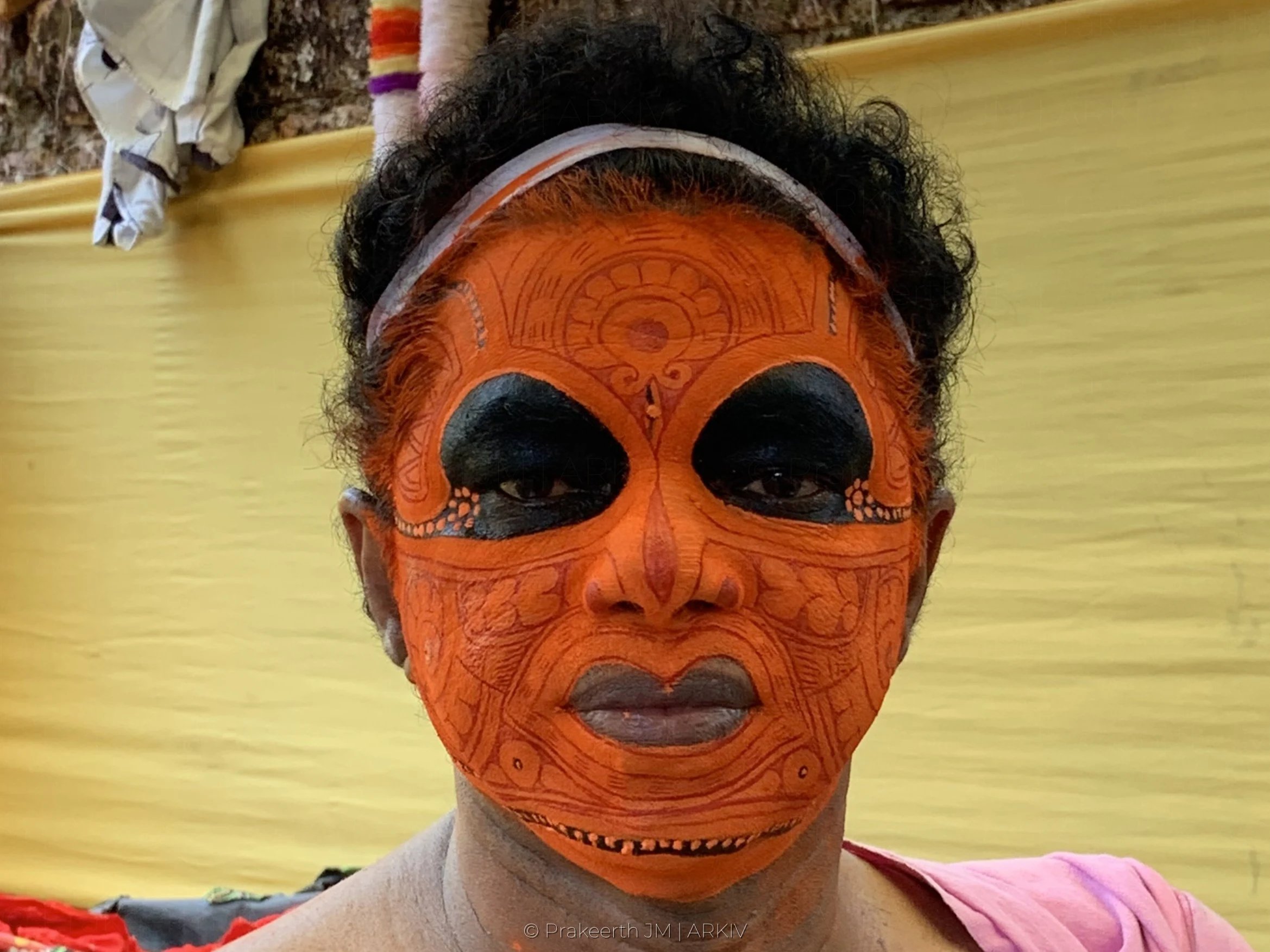
Kodumpurikavum Kozhippoovum is a traditional style of Mukhathezhuthu most commonly associated with Vishnumoorthi Theyyam.
The defining feature is the Kodumpurikam (“extended eyebrow”), in which the tail of the Karimashi outlining the eyes is drawn upward onto the forehead, creating a bold and elongated eye design.
Below the eyes, on either side of the nose, three or four Kozhippoovu (“rooster flower”) motifs are painted. These floral designs are one of the distinguishing characteristics of this facial painting style. The forehead is typically adorned with either a Pushpam (flower motif) or a Kuri (forehead mark), depending on the tradition followed.
In the Vadakkan Sampradayam (Northern tradition), the design of the lips differs slightly from other regional traditions. When Vishnumoorthi is performed in the Ottakolam (single-form) style, the facial painting changes from Kodumpurikavum Kozhippoovum to Vattakkannum Kozhippoovum, replacing the extended eye design with the traditional round eye pattern.
Theppum Kuriyum — Peedakkaalittezhuthu
Theppum Kuriyum — Peedakkaalittezhuthu is a traditional style of Mukhathezhuthu characterised by a simple facial base and a distinctive forehead motif known as the Peedakkaalittezhuthu.
Theppu refers to the application of Manayola across the face, creating a relatively simple base compared to more elaborate styles. The design painted on the forehead is known as the Kuri, of which three principal forms are traditionally used: Chandrakkala (crescent moon), Pushpam (flower), and Thrikkannu (third eye). Each Theyyam uses one of these three motifs based on the nature and iconography of the deity. The eye design may feature either the Vaalittezhuthiya Kannu (tailed eye) or the Vattakkannu (round eye), depending on the specific deity.
The defining feature of this variation is the Peedakkaalittezhuthu. Above the eyebrows, a curved line is painted using yellow Manayola, resembling the leg of a ceremonial Peedam (ritual pedestal). It is from this resemblance that the style derives its name.
This form of Mukhathezhuthu is commonly used for several Theyyams, including male deities such as Velutha Bhootham and their Vellattams, as well as many Chamundi Theyyams of the Payyanur region, including Moovalam Kuzhi Chamundi and Madayil Chamundi. In male Theyyams such as Velutha Bhootham, a painted moustache is also incorporated into the facial design.
Iratta Churulittezhuthu
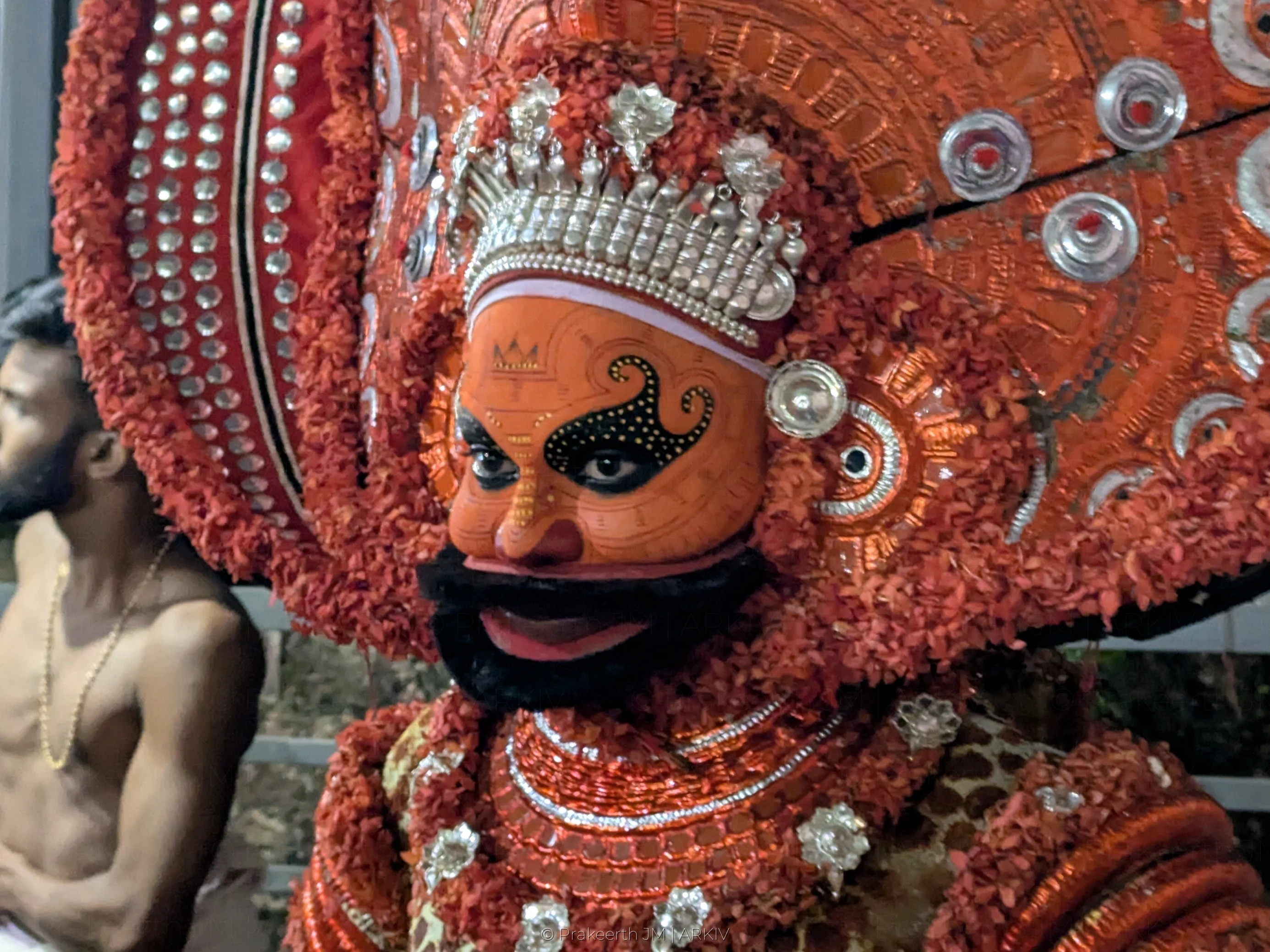
Iratta Churulittezhuthu (“Double Curl Style”) is a traditional style of Mukhathezhuthu commonly associated with deified warrior-heroes such as Gurikkal Theyyam and Kandanar Kelan.
The defining feature is the distinctive double-curl eye design. The eyes are outlined with Karimashi (black pigment), after which two curled extensions are drawn — one extending sideways from the eye and the other rising upward onto the forehead. The presence of these two curls gives the style its name, Iratta Churul (“double curl”).
Decorative Manayola dots are applied above the black eye design, across the forehead, on the cheeks, and over the bridge of the nose. These dotted embellishments complement the bold eye pattern and contribute to the striking appearance of this style, reflecting the heroic and powerful nature of the deified warriors for whom it is traditionally used.
Hanuman Kannittezhuthu
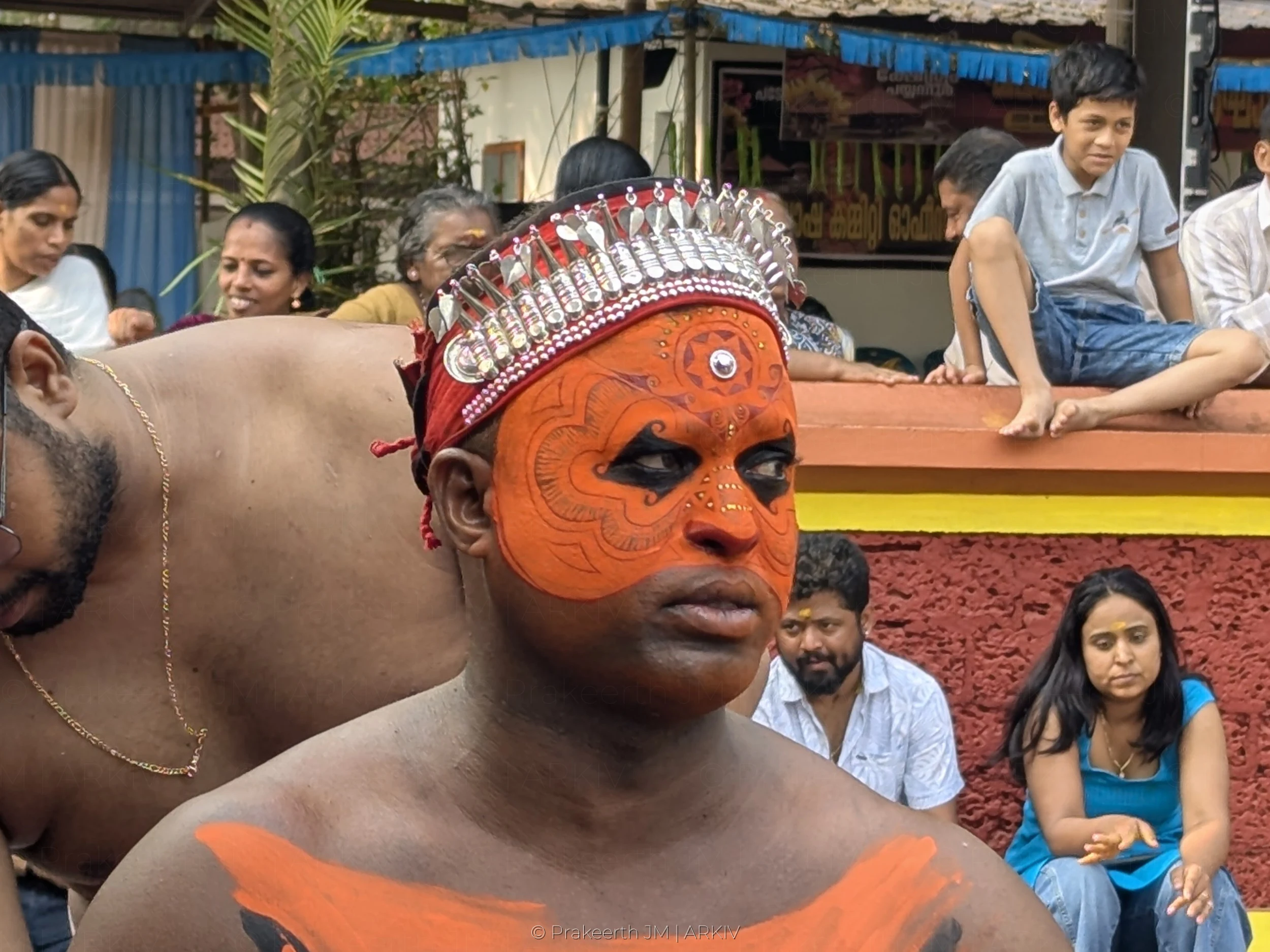
Hanuman Kannittezhuthu is a traditional style of Mukhathezhuthu used for Theyyams such as Hanuman and Bali. The name Hanuman Kannu refers specifically to the distinctive method of painting the eyes.
The defining characteristic is the eye design, which consists of three symmetrical curls of equal size. One curl is drawn above the eye, another below it, and the third extends outward to one side. Together, these balanced curls create a unique eye pattern that is immediately recognisable.
This eye design is intended to emphasise the vanara (simian) nature of the deity, reinforcing the iconography of Hanuman and other monkey-associated Theyyams through the facial painting.
Although Bali Theyyam features the same Hanuman Kannu eye pattern, its overall facial painting differs in other respects and is regarded as a separate style.
Ashtakon Kuriyum Erinjippoovum
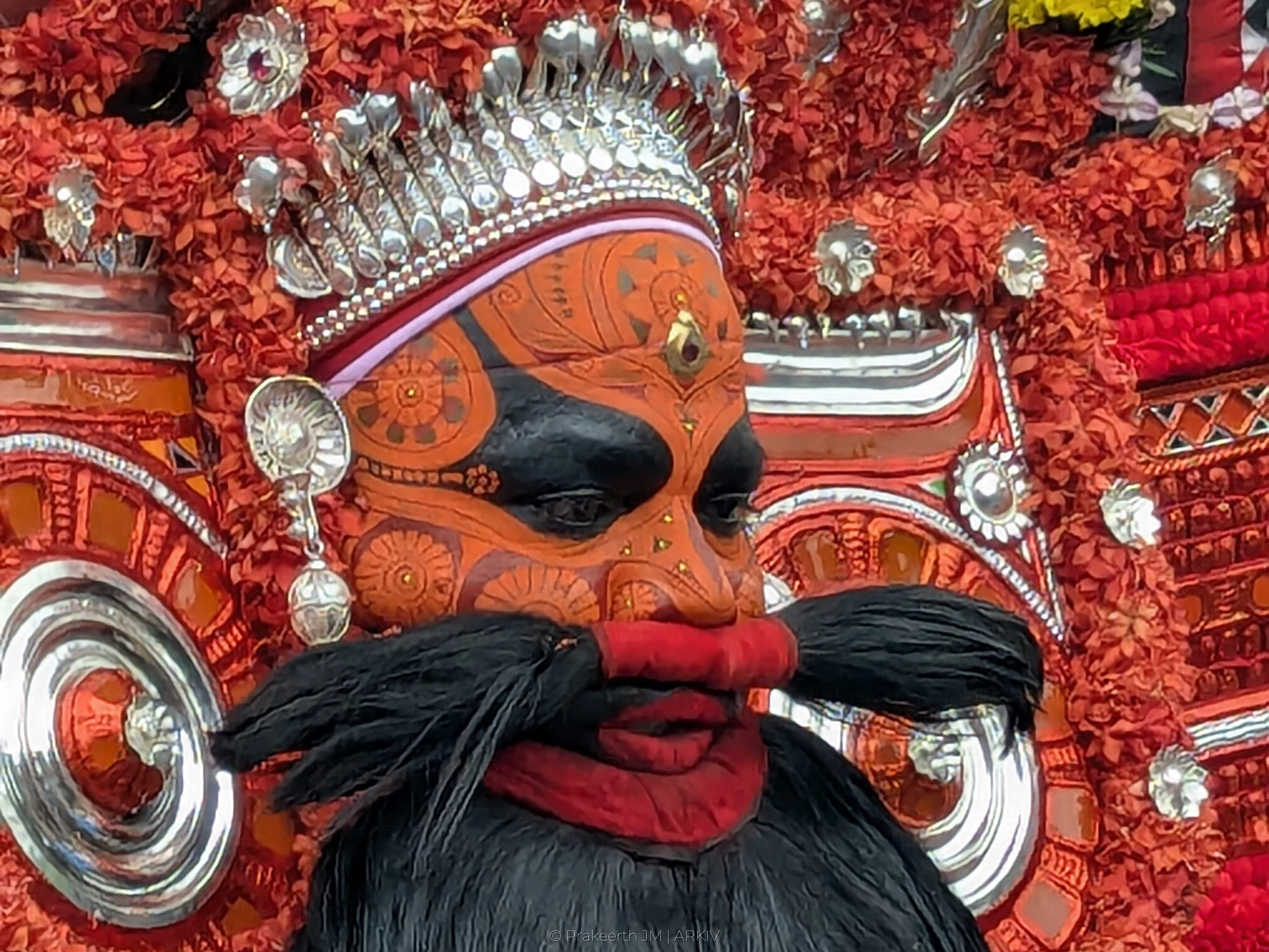
Ashtakon Kuriyum Erinjippoovum is a traditional style of Mukhathezhuthu commonly associated with Theyyams such as Kshethra Palakan and Padakkathi Bhagavathi.
The defining feature is the Ashtakon Kuri (“eight-sided forehead motif”) painted on the forehead. It consists of eight symmetrical angles radiating towards the eight cardinal and intercardinal directions, symbolising completeness and cosmic order. This motif is also referred to by some practitioners as Kshethrashtakam. At the centre of the Ashtakon Kuri, an Erinjippoo motif is painted as the focal point of the forehead design.
The eyes are outlined with Karimashi in the Valiya Shankh (“large conch”) style, with the tail of the eye design extending upward onto the forehead. Above the black eye pattern, decorative dots and a floral motif are painted on either side, adding depth and ornamentation to the facial composition.
Below the eyes, on either side of the nose, Erinjippoo motifs are painted, creating a balanced floral arrangement that characterises this style.
In Padakkathi Bhagavathi, the beard area is traditionally painted with Chaayilyam rather than Karimashi. In recent years, however, some performers have adopted black pigment for the beard instead, representing a departure from the older convention.
Kutti Shankhum Vairi Dalavum
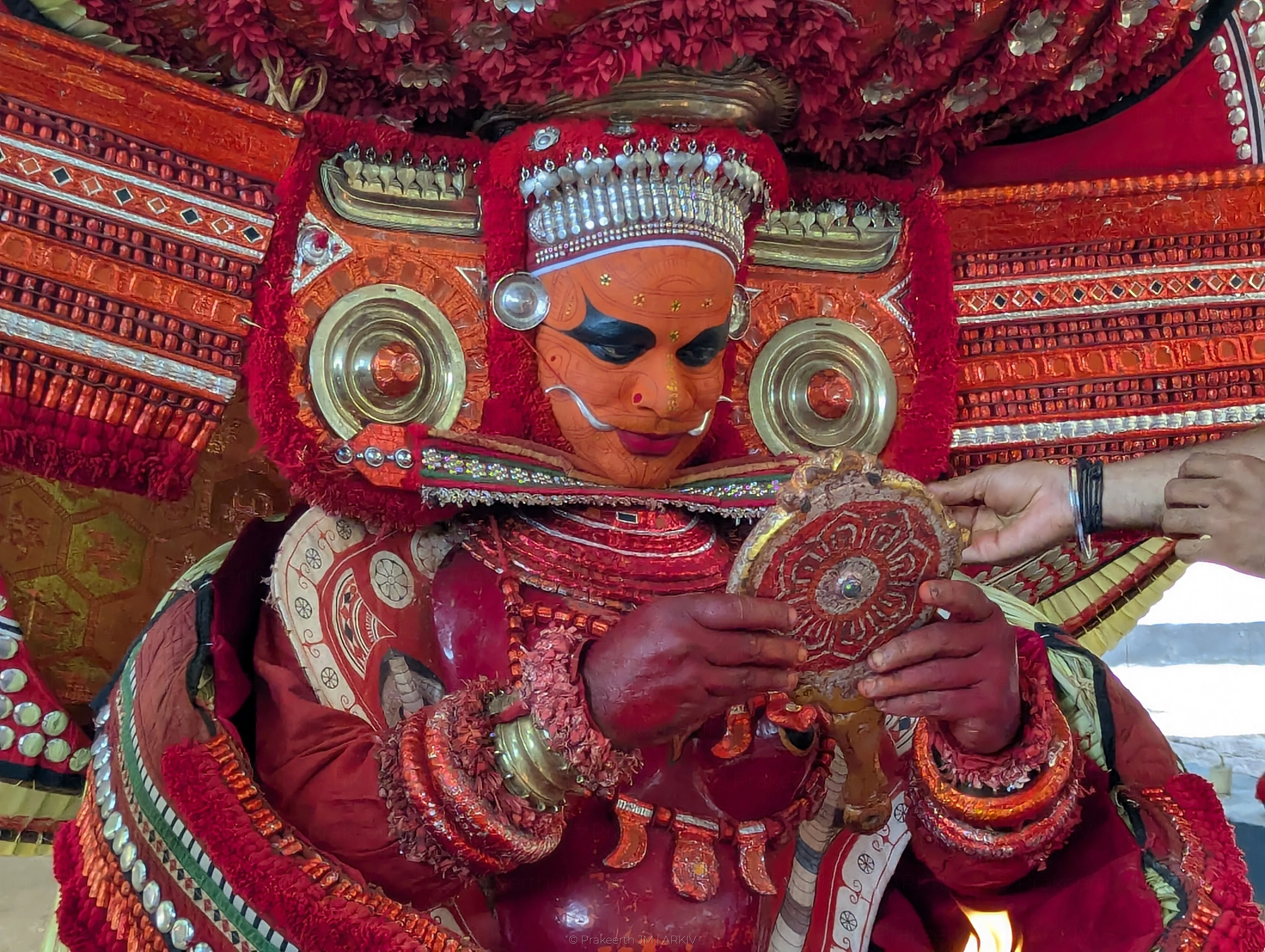
Kutti Shankhum Vairi Dalavum is one of the most widely used styles of Mukhathezhuthu in Theyyam. It is predominantly associated with Bhagavathi Theyyams adorned with a Vatta Mudi (circular headdress), Uda, and Pantham. A defining feature is the presence of Vairi Dalam motifs on the cheeks.
The eye design is known as Kutti Shankh (“small conch”). The eyes are outlined with Karimashi, and the end of the conch-shaped pattern that extends towards the forehead is finished with a sharp, pointed tip. There are differing interpretations regarding the exact meaning of the term Kutti Shankh among Theyyam artists — some hold that it refers to the conch-shaped eye pattern itself, while others maintain it denotes a small conch-like motif positioned near the ears, adjacent to the Vairi Dalam. Even among experienced artists, there is no complete consensus on this point.
A further distinction lies in comparison with the Valiya Shankhum Praakkazhuthum style used for Thaai Paradevatha Theyyams. In that style, the pointed end of the eye pattern extends much higher onto the forehead, while in Kutti Shankhum Vairi Dalavum it remains shorter.
This style is commonly used for Vattamudi Bhagavathi Theyyams such as Panayakkaattu Bhagavathi, Kanakkara Bhagavathi, and Angakkulangara Bhagavathi. In general, Theyyams adorned with this style are regarded as embodying a Saumya Bhava — a gentle and benevolent aspect of the deity.